


Oil jumped during Asian trading hours as fresh tensions over Iran keep markets on edge, weighing on equities and fueling safe-haven assets to new highs.
Asian indexes were broadly lower early Thursday, while Brent oil futures rose above $68 barrel—the highest since September.
South Korea’s Kospi fell 1.4% before paring some losses to trade 0.2% lower, while Australia’s S&P/ASX 200 lost 0.8% and Taiwan’s Taiex was 0.3% lower. Japan’s Nikkei Stock Average declined 0.1%.
Gold and silver, viewed as safe ports in market storms, climbed after President Trump said Wednesday that “a massive Armada” was heading to Iran, saying time was running out for the country to make a deal on nuclear weapons.
The fleet was larger than the one sent to Venezuela, he said, adding: “Like with Venezuela, it is, ready, willing, and able to rapidly fulfill its mission, with speed and violence, if necessary.”
The range Trump’s latest threat on Iran could have on oil markets is wide, said Vivek Dhar, analyst at Commonwealth Bank of Australia. The fallout could ultimately cause limited disruption to Iranian oil production, with energy infrastructure completely spared, or spur possible retaliation by Iran—or anything in between, Dhar said.
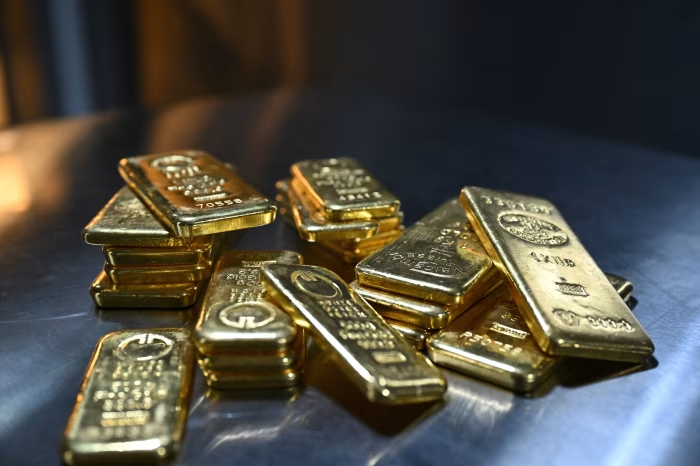
Precious metals continued their relentless climb as the jitters added to an already strong push to rotate into gold and silver.
Spot gold was last 1.4% higher at $5,490.11 per troy ounce after earlier crossing the $5,500 psychological level. Spot silver rose 0.8% to $117.55 after hitting $119.40 earlier, ICE data show.
An increasingly unpredictable U.S. political backdrop is amplifying the risk-off mood, Saxo Bank’s head of commodity strategy Ole Hansen said.
A potential U.S. government shutdown has been a source of concern as time runs out on lawmakers to pass a funding package.
Markets are also parsing the U.S. Federal Reserve’s latest decision to keep rates unchanged—the first hold since July—and earnings results from major U.S. companies as reporting season gets underway.
Asian currencies mostly strengthened against the dollar early Thursday as traders weighed Fed rate-cut prospects and comments from Treasury Secretary Scott Bessent.
Bessent told CNBC on Wednesday the U.S. is committed to a strong dollar and isn’t intervening in currency markets, lending some support to the greenback after a selloff this week fueled in part by Trump, who said he wasn’t concerned about currency declines.
“We think the U.S. dollar may still stay vulnerable amid policy risks,” Lloyd Chan, senior currency analyst at MUFG, said in a note.
USD/JPY was down 0.4% at 152.83, while USD/KRW dropped 0.3% to 1,425.53.
