


Many parts of the world are experiencing a housing crisis, with demand in urban areas often outpacing supply, leading to soaring prices.
In countries including the UK and the US, an aging population of builders combined with a drive to fill the housing shortage means there is a need for more construction workers. The UK’s Construction Industry Training Board found that the country will need 250,000 more workers by 2028 to meet building targets but in 2023, more people left the industry than joined.
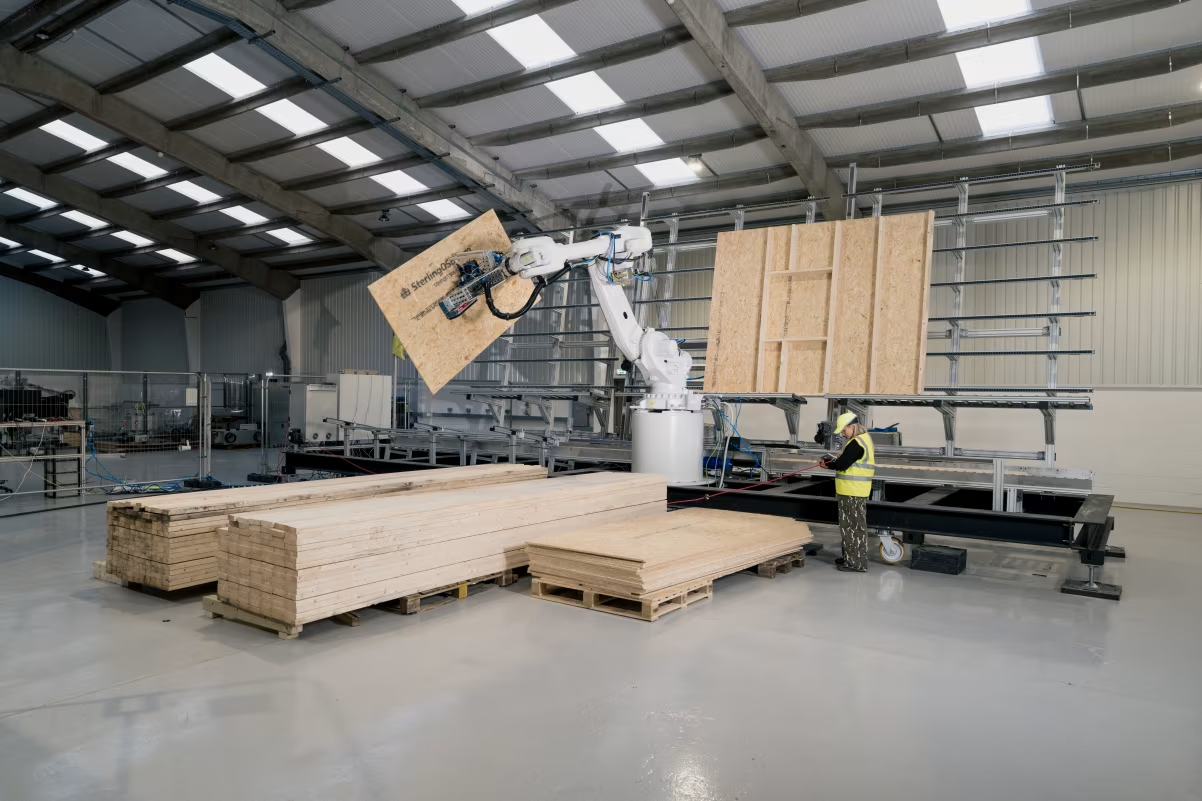
UK technology company Automated Architecture, or AUAR (pronounced “our”) believes it has a solution. It makes portable micro-factories that can produce the wooden framing of a house — the walls, floors and roofs. Co-founder Mollie Claypool says the micro-factories will be able to produce the panels quicker, cheaper and more precisely than a timber framing crew, freeing up carpenters to focus on the construction of the building.
Despite the focus on automation, Claypool insists she is not trying to put anyone out of work. “Automation isn’t replacing jobs. Automation is filling the gap,”
AUAR charges a developer by the square foot to produce the timber panels of a home. To begin, architects send AUAR the building plans, and its software, Master Builder, uses AI to calculate how many panels are needed, and exactly how much timber the developer needs to buy.
The micro-factory fits into a shipping container which is sent to the building site along with an operator. Inside the factory, a robotic arm measures, cuts and nails the timber into panels up to 22 feet (6.7 meters) long, keeping gaps for windows and doors, and drilling holes for the wiring and plumbing. The contractor then fits the panels by hand.
One micro-factory can produce the panels for a typical house in about a day — a process which, according to Claypool, would take a normal timber framing crew four weeks — and is able to produce framing for buildings up to seven stories tall.
Claypool launched the company in 2019 with Gilles Retsin, after working together at The Bartlett School of Architecture, part of University College London, where they focused on automation and technology in architecture.
She says their service is 30% cheaper than a standard timber framing crew, and up to 15% cheaper than buying panels from large factories and shipping them to a site.
It is also more environmentally friendly, Claypool claims. “Timber is a natural material, which means it has bends, it twists, sometimes it has bits taken out of it, it has knots,” she explained. The micro-factory responds to flaws in the wood and calculates how best to work with the available material, reducing wasted wood.
She adds that the precision of the micro-factories means that the panels fit together tightly, reducing the heat loss of the final home, making them more energy efficient.
